How Do I Read Magnetize a Magnet
Remagnetizing Fridge Magnets 


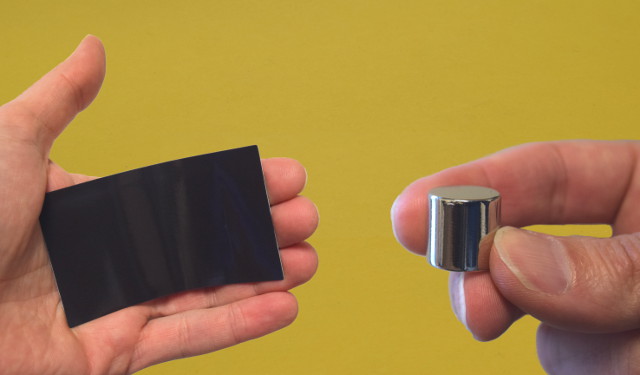
A flexible magnet and a neodymium magnet
Can a flexible fridge magnet be re-magnetized using neodymium magnets? Aye! Read on to learn how.
We've been asked this question a number of times, and then it seems like a skillful idea to demonstrate the procedure. We'll use a handful of neodymium magnets to re-magnetize a flexible magnet. While at that place'south a slicker, faster setup used in the manufacturing of flexible magnets, our demo shows the basic idea. When companies manufacture large sheets of this stuff, they use a very similar process to magnetize larger sheets.
What is a flexible magnet?
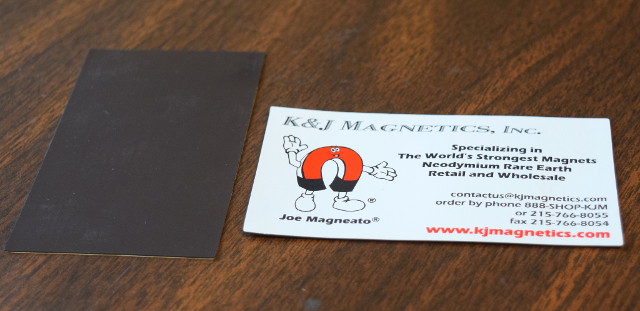
A flexible magnet with printed graphics
Unlike the neodymium magnets we provide, flexible magnets are non made with rare earth elements. They are a mix of ferrite powder (remember ferrite or ceramic magnets) mixed into a prophylactic or polymer resin. It'southward magnet material grit mixed into a flexible plastic canvass.
They're often sold in rolls, similar record, or in sheets. Many are sold with i side that can be printed on, which is why you see and then many graphics on them. Most magnets you come across on the backs of cars are made with this kind of flexible magnet material.
Are they strong?
No. They are not nearly as strong every bit a neodymium magnet in several important means. First, let's consider pull force. The pull force is much, much weaker than a neodymium magnet. Depending on how y'all measure out it, a neodymium magnet is going to exist roughly 7-20 times stronger than a flexible magnet of the same size. In some cases, this number can be even higher.
Of course, flexible magnets don't have to be very strong to simply hold themselves on the back of your car. They're not lifting very much. They don't stick out into the wind. They are really swell for funny bumper "stickers." Simply don't look to elevator heavy weights with one.
Longtime readers of our weblog know that pull force isn't the only important measure of a magnet'southward strength. Coercivity is besides key. Coercivity is a magnet'southward resistance to getting demagnetized past a magnetic field. The greater the coercivity, the stronger magnetic field you demand to magnetize (or de-magnetize) it.
For example, rubbing a strong magnet across a credit card's magnetic strip can erase the information on it. That's because the strip's coercivity is depression. It is unable to resist the magnetizing field from the magnet.
Flexible magnets are the same style. Because their coercivity is low, they're hands influenced by a powerful neodymium magnet.
What practice Halbach arrays have to practice with it?

Before nosotros show how to remagnetize a flexible magnet, let'south take a await at how they should be magnetized in the first identify. Back in our commodity about Halbach Arrays, we showed how flexible magnets are magnetized in multiple directions. They're not magnetized in 1 management throughout, like a unproblematic neodymium disc magnet.
Flexible magnets are magnetized in alternating patterns, where the polarity changes as you movement to different positions forth the surface. If y'all could brand yourself actually small and walk around the surface with a tiny compass or pole identifier, you lot would see alternating due north and s poles.
That sounds too complicated. Can't I just magnetize it in ane direction and be washed already?
No, not if you want the flexible magnet to piece of work. Remember, these things aren't very powerful. If you lot magnetize it all in i management, it's non able to provide much magnetic forcefulness at all. It won't stick to the fridge door.
By magnetizing flexible magnets in alternating directions like this, you can go a good amount of strength from what would otherwise exist much too weak. It's really quite ingenious. The alternating fields both requite it more forcefulness and help it to resist demagnetization.
How can I magnetize the flexible magnet in all those crazy directions?
Back in our article about horseshoe-shaped magnets, we used a neodymium magnet to re-magnetize an Alnico horseshoe magnet. Information technology was pretty elementary to choice which pole to touch the horseshoe magnet. When we stick ane pole of the strong neo magnet against the weaker horseshoe magnet, information technology is magnetized in the direction of the field it sees.
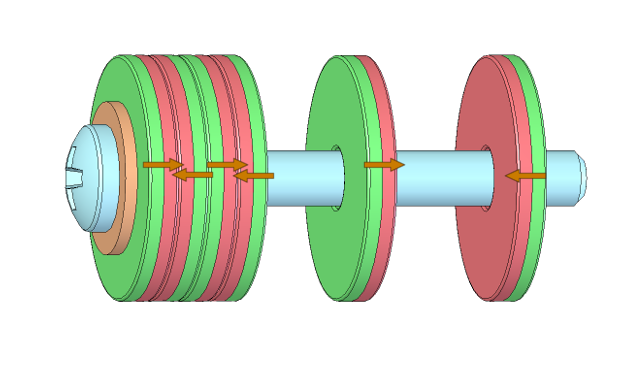
Magnets are stacked with like poles facing one another, repelling each other.
For the flexible magnets, we demand a way to brand the strip "see" that alternate design. How can we practise that? By stacking a agglomeration of sparse disc or band magnets together, bundled so that they are repelling i some other. This makes a strong magnetic field forth the border of the stack, shaped in exactly that alternating pattern we want.
This is a bit challenging to get together, since the magnets act to repel each other apart. We apply a long screw and nut to hold the stack together.
How does that piece of work?
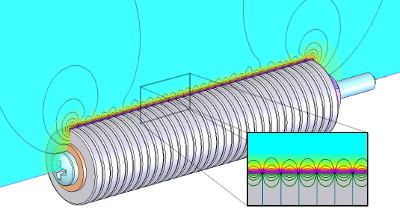
Stack of R821 ring magnets on a screw, repelling with similar poles facing one another.
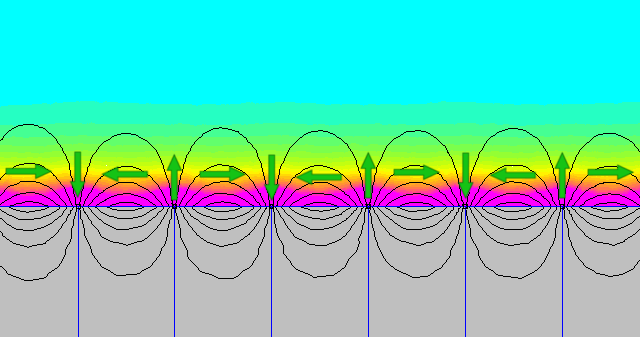
Now that the stack is assembled, permit'due south visualize what the field looks similar right nearly the curved surface of the cylindrical stack of magnets. The black lines of flux bespeak the field management at a given point. The field direction is parallel to those black lines.
If yous motility from left to right forth the surface, you see the field direction changing. In the lower picture, the green arrows show the field direction. Say, that looks a lot similar a Halbach array!
If we roll or slide a flexible magnet right upwards confronting this stack of neodymium magnets, the flexible magnet will "run across" that strong magnetic field in the directions shown. Afterward the stack of neodymium magnets are slid away, the flexible magnet retains magnetization in those directions.
In the video below, we:
- accept a new flexible magnet and show its alternate fields using a piece of MV43 dark-green viewing film,
- wipe a relatively big neodymium magnet beyond the face of it, irresolute the magnetization management and eliminating the pattern, and
- roll a stack of R821 band magnets beyond it to make new patterns.
That video used R821 ring magnets and the MV43 viewing film.
Let'due south go artistic with odd patterns.
Flexible magnet manufacturers tend to favor that blueprint of long stripes, mainly because it'south easy to magnetize big sheets chop-chop. Just roll the sail beyond the assortment of neodymium magnets, and viola! You're done.
To make things a little more interesting, nosotros can also make other patterns. If they're alternate patterns, they can as well provide skilful strength. In the video below, we magnetize it with a checkerboard blueprint of n and south, plus a few other silly patterns.
That video used MV43 viewing picture, D28 and D18 cylinder magnets to draw things, and an array of B224 magnets for the checkerboard.
Source: https://www.kjmagnetics.com/blog.asp?p=remagnetize-flexible
0 Response to "How Do I Read Magnetize a Magnet"
Enregistrer un commentaire